
How to Backtest Small-Cap Trading Strategies Without Writing Code
Quick Answer
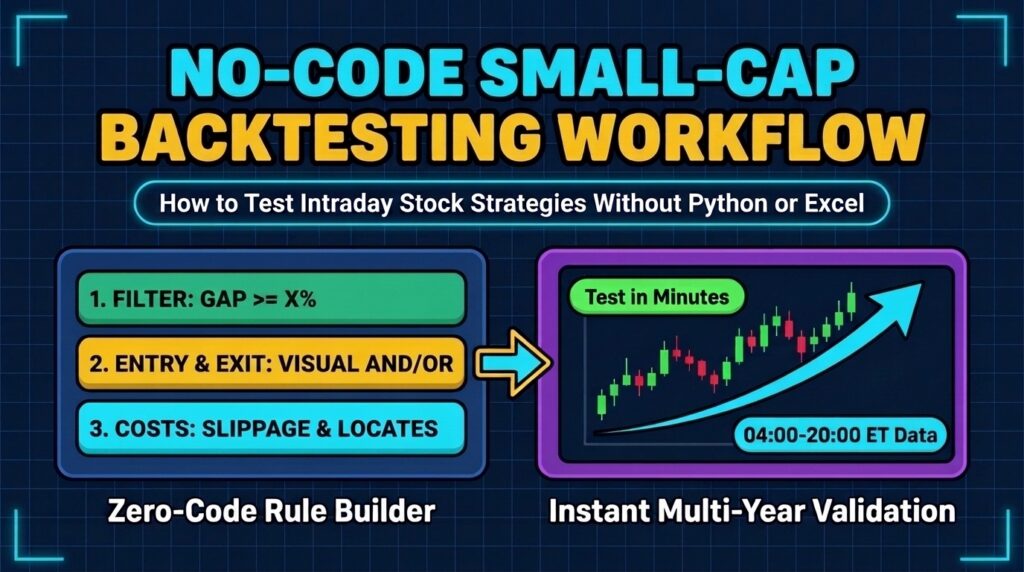
To backtest small-cap trading strategies without writing code, use dedicated no-code backtesting software built for 1-minute extended-hours data (04:00 to 20:00 ET), delisted tickers, and real execution costs like slippage and short locate fees. A repeatable workflow follows five steps: (1) define the stock universe, (2) configure risk and trading costs, (3) stack visual AND / OR entry rules, (4) set stop and time exits, and (5) validate edge across multiple dimensions before risking live capital.
Why Generic Stock Backtesters Fail on Small Caps
Most retail backtesting software was designed for SPY swing trades or crypto. Small-cap gappers break those tools for two structural reasons: survivorship bias (many micro-caps delist or reverse-split) and execution friction (wide spreads, halts, and hard-to-borrow locate fees).
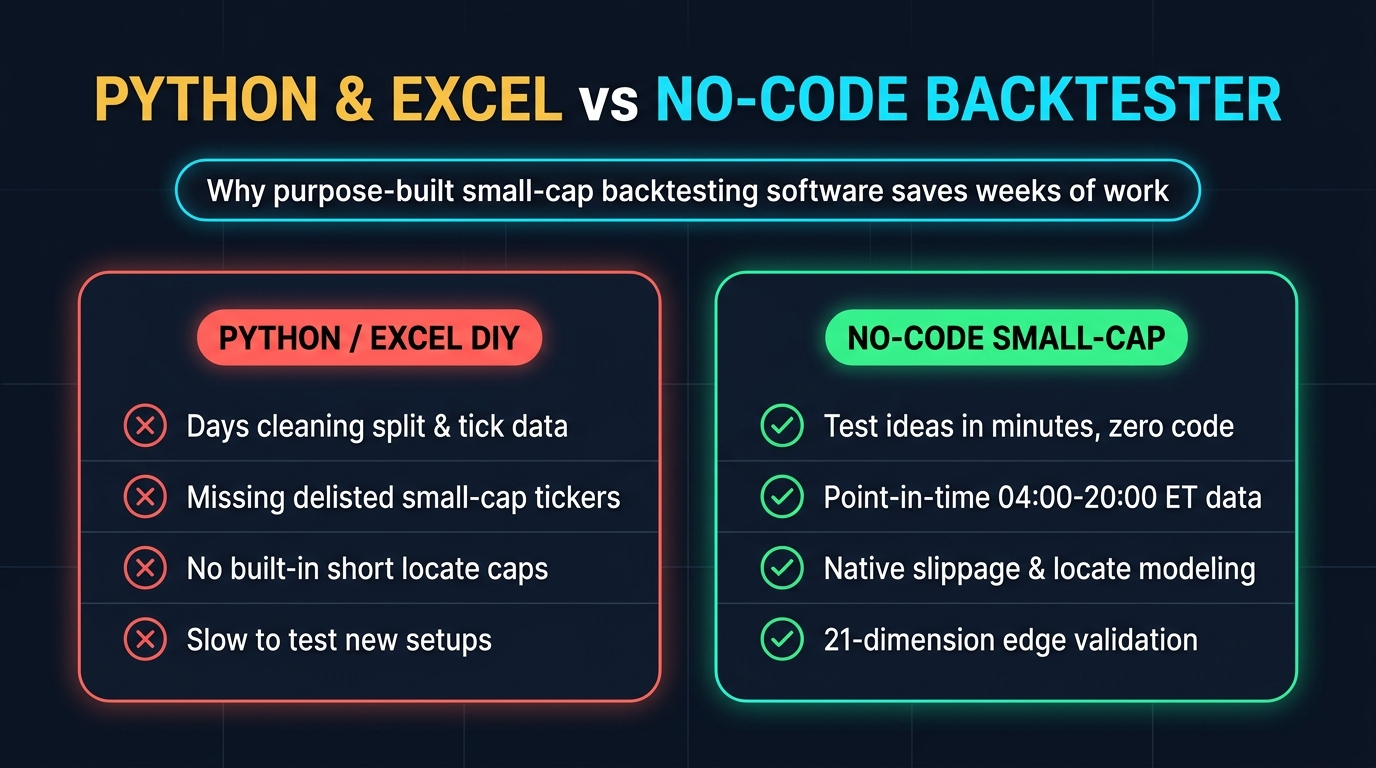
- Python (DIY): Great flexibility, but you spend weeks cleaning split-adjusted tick data, stitching premarket bars, and debugging look-ahead bias instead of testing setups.
- Excel / Manual Logs: Useful for reviewing 30 trades, useless for statistical confidence. Logging 500+ intraday sessions by hand takes months and introduces hindsight bias.
- Generic Charting Platforms: Focused on single symbols rather than multi-ticker universe screening (Gap >= 20%, Market Cap < $300M), with no native short locate modeling.
The 5-Step No-Code Backtesting Workflow
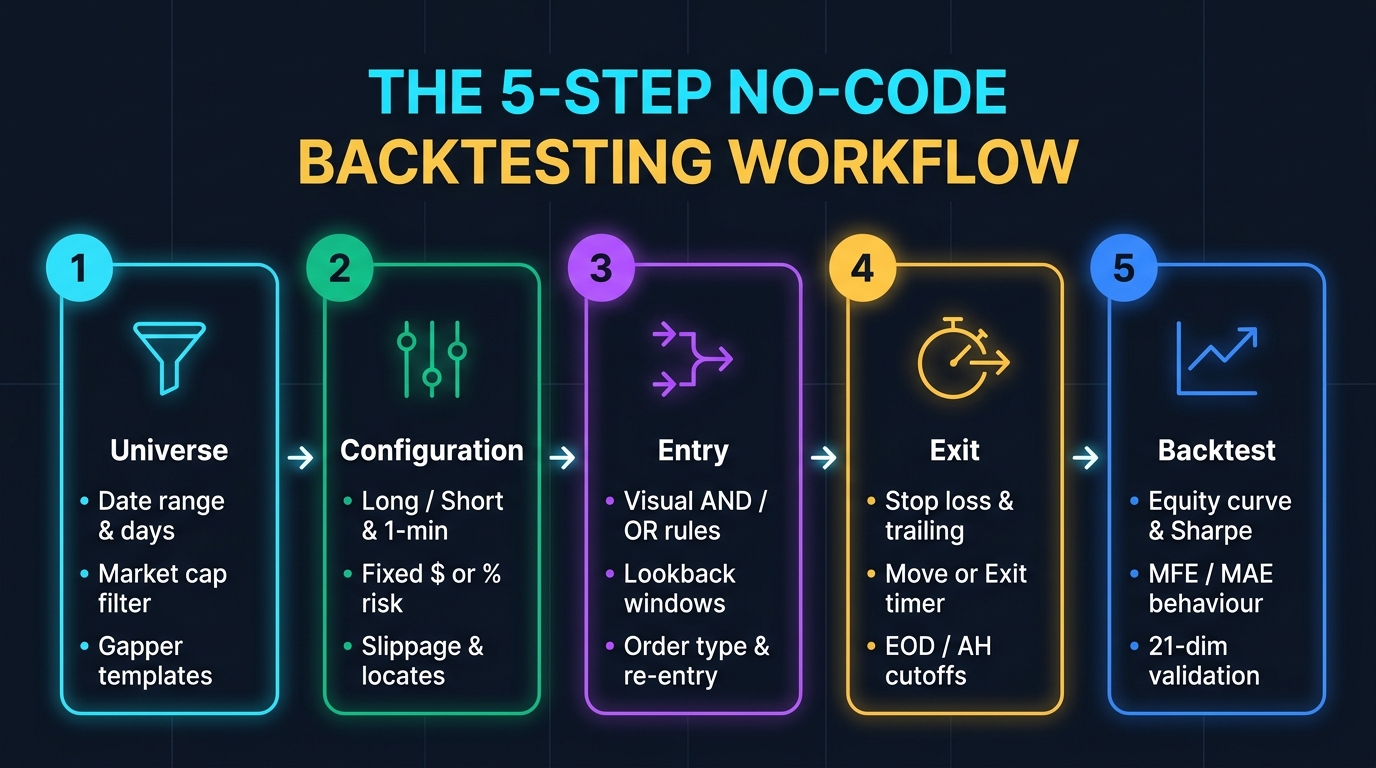
Modern no-code backtesting replaces custom scripts with a structured five-stage pipeline (Universe -> Configuration -> Entry -> Exit -> Backtest). Below is what each step looks like inside GapperLab using a generic small-cap demo.
1. Universe (Choose Your Ticker-Days)
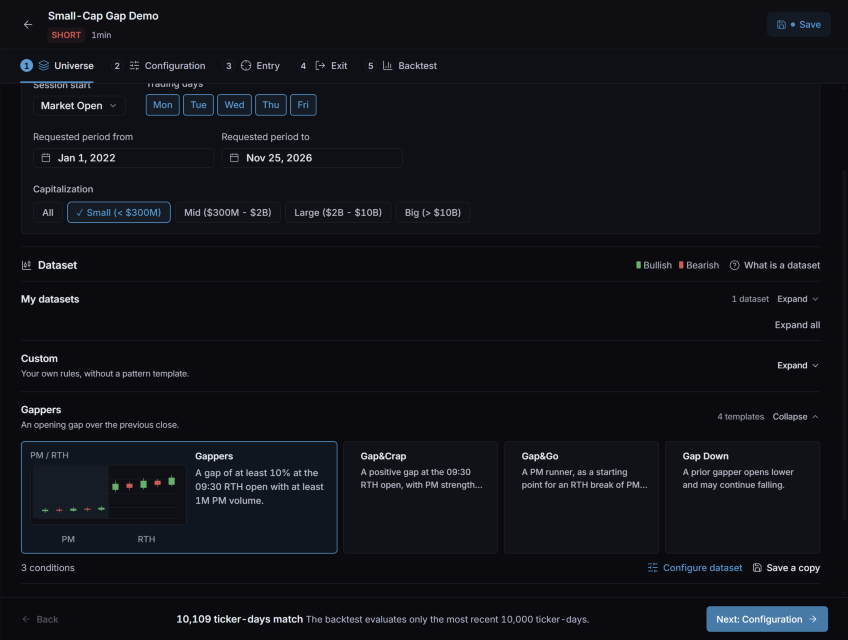
Instead of testing one ticker, small-cap backtesting runs across ticker-days (every historical session that matches your scanner rules). Filter by date range (ideally 3 to 5 years), day of week, market cap (Small < $300M), and ready-made pattern templates (Gappers, Gap&Go, Gap&Crap, Gap Down, or custom rules).
New to how opening gaps are measured? Read What Is a Gapper? Stock Gaps & Opening Gaps Explained.
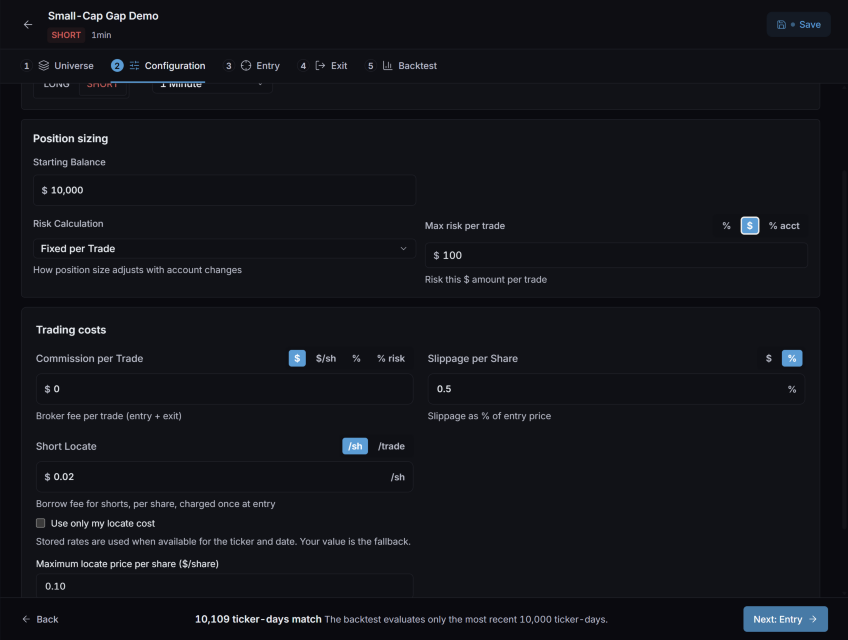
2. Configuration (Risk Sizing & Execution Realism)
Choose your direction (LONG or SHORT), candle timeframe (1-Minute), and position sizing (Fixed per Trade in dollars or % acct). Then layer in real small-cap trading costs directly in the interface:
- Commissions & Slippage: Set per-share or percentage friction (such as 0.5% slippage) so thin liquidity and fast tape are reflected in every fill.
- Short Locate Caps: Define borrow cost plus a hard Maximum locate price per share ($/share) so prohibitively expensive tickers are skipped automatically.
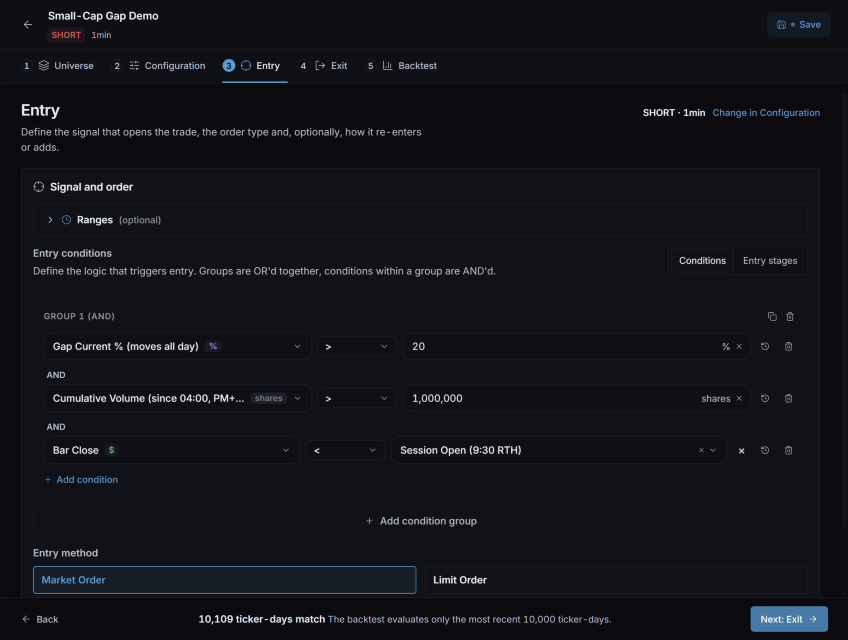
3. Entry (Visual Boolean Logic)
Build entry triggers with AND / OR rule blocks instead of code. Conditions inside a group must all be true (AND), while additional groups act as alternative triggers (OR). From the same panel, attach lookback windows, time ranges, order type (Market or Limit), pyramiding, and daily re-entry limits.
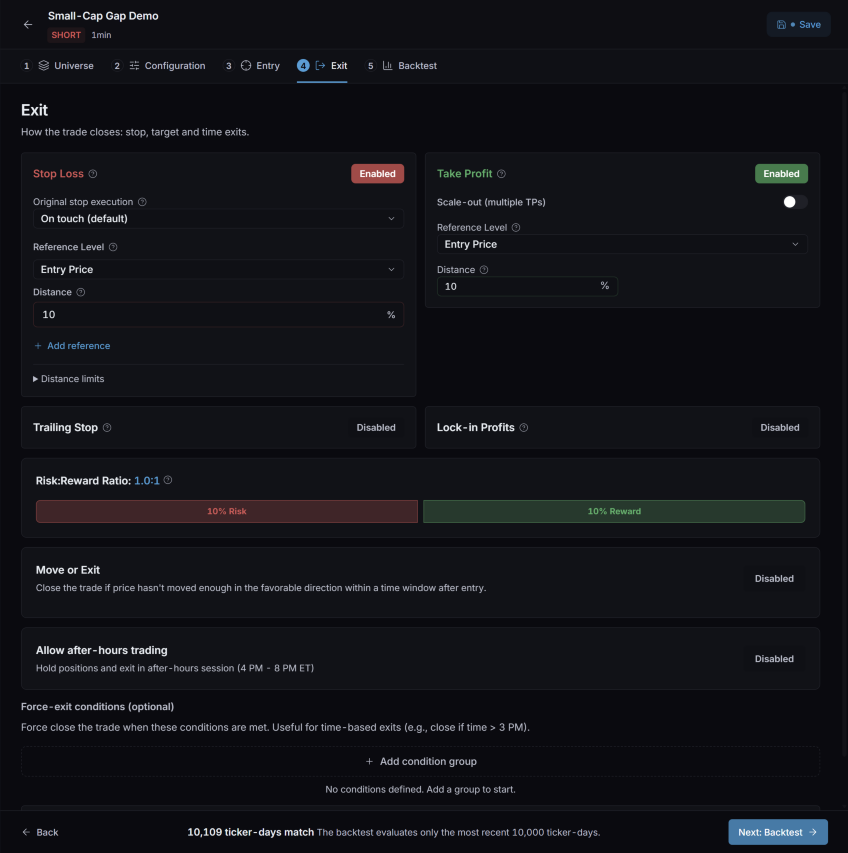
4. Exit (Stops, Targets & Time Cutoffs)
Entries get the attention, but exits control your payoff ratio and tail risk. Configure your Stop Loss (On touch), optional Take Profit or Trailing Stop, a Move or Exit timer (closes stagnant trades automatically), and End-of-Day or After-Hours session cutoffs.
5. Backtest (Run & Keep Updated)
Review all four stages on one summary screen and execute the simulation across years of 1-minute data in seconds. You can also toggle automatic updates so new market sessions feed into your results without re-running manually.
Build Your First Small-Cap Backtest in 5 Minutes
Test your own gapper, bounce, or momentum rules across years of 1-minute extended-hours data without writing a single line of code.
Create Free GapperLab Account →What No-Code Small-Cap Research Uncovers
To see how much difference structured backtesting makes, look at four empirical findings from GapperLab’s published small-cap studies (all built without writing code):
| Study | Sample | Key Quantitative Finding |
|---|---|---|
| 10 AM Switch & Tail-Risk | 24,111 sessions | 86.9% red close when HOD holds past 10:00 AM ET, but 8.7% of bleeders squeeze parabolically |
| Slippage in Small Caps | 543 trades | Just 0.5% execution slippage cuts net return by -76.1% (+80.0% down to +19.1%) |
| Day of the Week Edge | 1,031 trades | Excluding Thursdays lifted out-of-sample Sharpe from 2.12 to 2.52 |
| Late Day Fade Erosion | 5 time windows | 2:00 PM ET entries peaked at +157.7% (1.01 Sharpe) vs. earlier and later windows |
- High win rate can hide tail risk: A single parabolic squeeze can erase weeks of small wins if your stop rules are not stress-tested.
- Zero-friction backtests lie: Always verify that your edge survives realistic slippage and short locate costs before sizing up.
- Timing matters as much as the setup: Slicing results by entry window and day of week often improves risk-adjusted returns more than adding extra indicators.
Beyond the Equity Curve: A 4-Point Validation Checklist
A smooth equity curve can still be the result of curve-fitting. Before trading a strategy live, run these four checks inside your stock backtester:
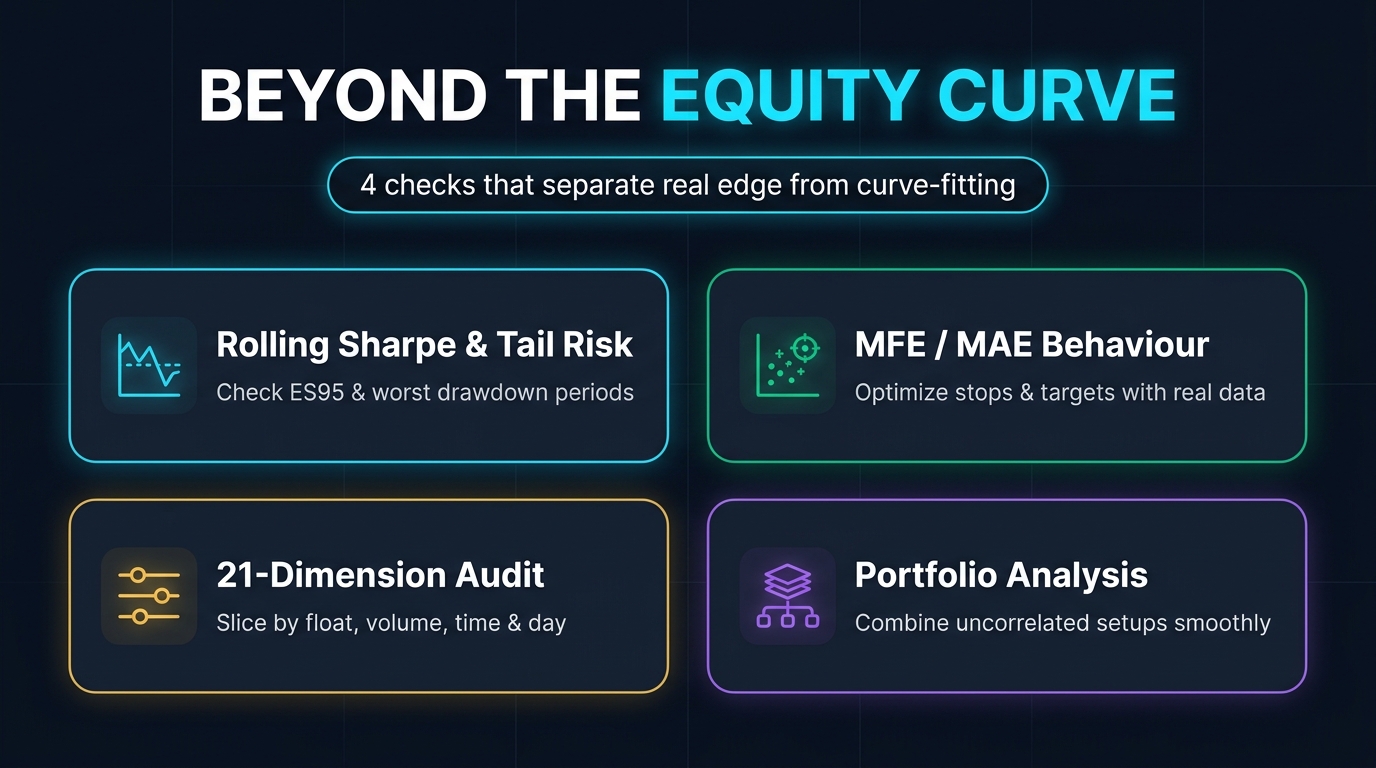
- Rolling Sharpe & Tail Risk: Check Rolling Sharpe, monthly heatmaps, and ES95 (Expected Shortfall) to see how the strategy behaves during slow or choppy regimes.
- MFE / MAE Behaviour: Compare Maximum Favorable Excursion (how far winners run) against Maximum Adverse Excursion (how much heat trades take) to calibrate stops and targets with data instead of guesses.
- 21-Dimension Audit: Slice performance across Float Size, PM Volume, Gap Size (%), Market Cap, Sector, Entry Time, and Day of Week to spot where edge is concentrated.
- Portfolio Analysis: Combine multiple uncorrelated strategies (longs, shorts, small-caps, mid-caps) to smooth overall account drawdowns.
Frequently Asked Questions (FAQ)
Do I need Python to backtest small-cap trading strategies?
No. Dedicated no-code backtesting software like GapperLab lets you screen small-cap universes, build boolean entry and exit rules, model slippage and short locates, and analyze 5+ years of 1-minute data without writing code.
Why is backtesting small caps harder than backtesting SPY or large caps?
Small-cap stocks experience extreme intraday volatility, frequent trading halts, wide spreads, locate fees, and high delisting rates. Generic tools that ignore delisted tickers or extended-hours volume produce inflated results that fail in live trading.
How many trades make a small-cap backtest statistically reliable?
Aim for at least 200 to 300+ trades across 3 to 5 years of data. A 25-trade sample can look profitable by pure luck; a 300+ trade sample across hot, choppy, and slow markets gives far higher confidence that your edge is real.
Can a no-code stock backtester model short locates and slippage?
Yes. In GapperLab’s Configuration step, you can set per-share or percentage slippage, commissions, and hard maximum locate caps so unshortable or overpriced tickers are excluded automatically.
Explore More GapperLab Quantitative Research
- What Is a Gapper? Stock Gaps & Opening Gaps Explained
- What Is Slippage in Trading and How to Model It in Small Caps
- Does the Day of the Week Matter in Trading? In-Sample vs. Out-of-Sample Study
- Small-Cap Gapper Statistics: 10 AM Switch & Tail-Risk
- Steven Dux’s Bounce Short Strategy: 2022 to 2026 Quantitative Backtest
- Edge Erosion in Small-Cap Trading: Is the Late Day Fade Strategy Dead?
Ready to Test Your Small-Cap Rules Without Writing Code?
Join systematic small-cap traders validating intraday setups on clean point-in-time data.
Get Started Free on GapperLab →For educational purposes only. Trading involves risk. Past performance does not guarantee future results.